
Exhibition
“The Manuscript Found in Saragossa” from Jean Potocki, investigation into a novel world
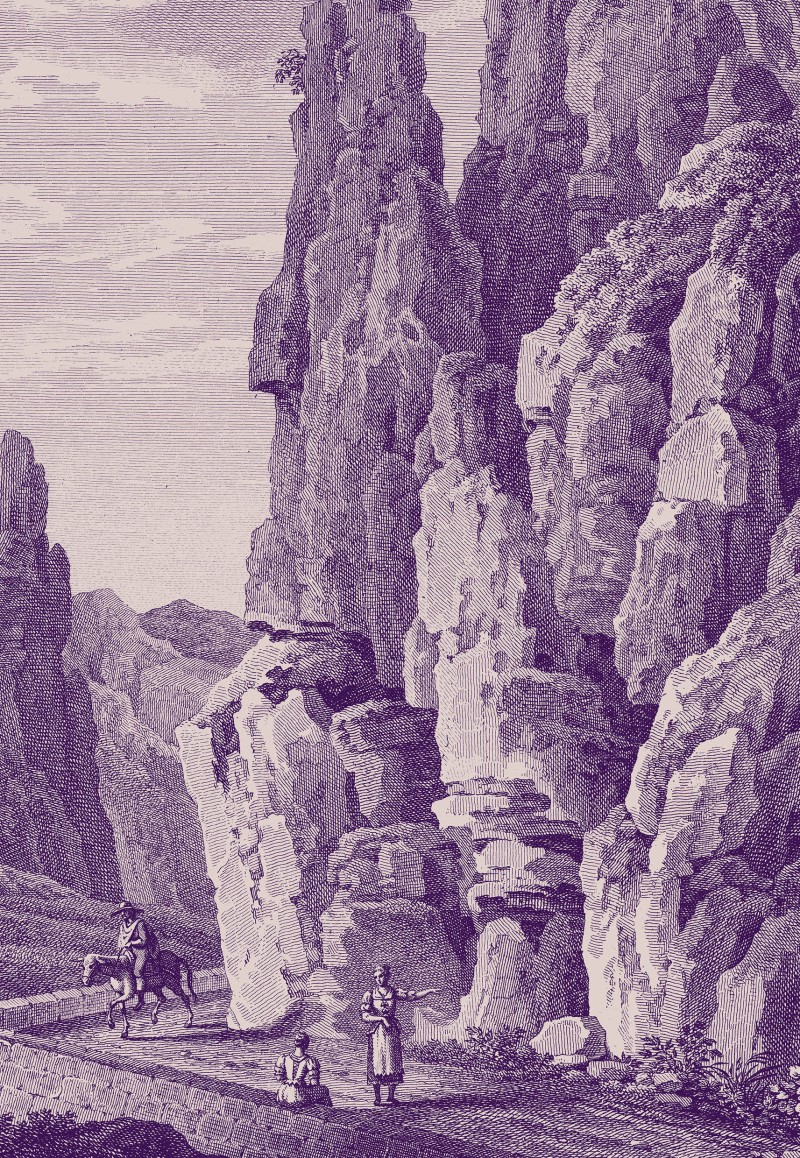
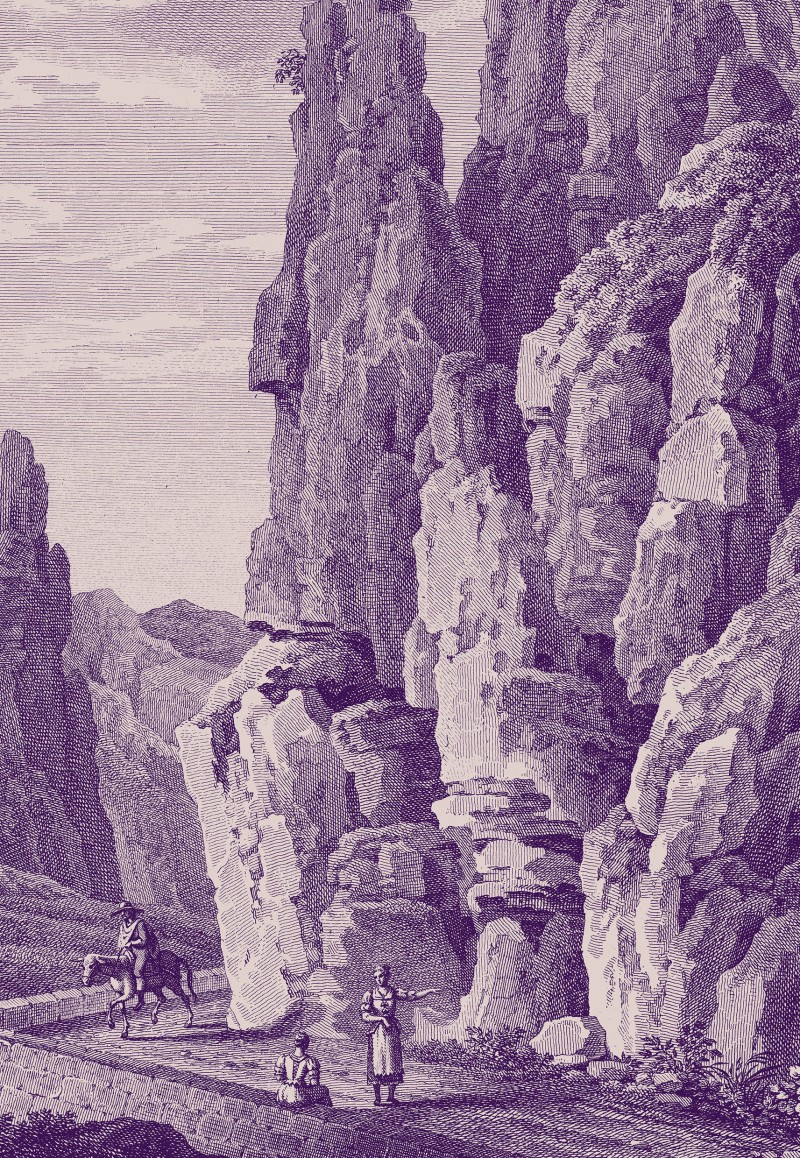
Liger (dessinateur) et Piriger (graveur), Vue du passage de la Sierra Morena nommé Despeñaperros (détail), [XIXe siècle]
Graphisme : Karen Ichters
Introduction
In the waning years of the Enlightenment, somewhere between the Ukrainian plains of Podolia and the byways of Spain a novel with the enigmatic title of The Manuscript Found in Saragossa gradually took shape. The book itself and the story of how it came to be would prove both turbulent and legendary. Written in French between 1794 and 1815, this monumental work of fiction sprang from the imagination of the singular Polish count Jan Potocki (1761-1815), a scholarly traveler, historian, and scientist. The Manuscript Found in Saragossa was penned incrementally and underwent countless revisions while a series of publishers gathered the leaves of Potocki’s manuscript and brought out editions that were partial, abridged, or unfaithful to the original. It was only two centuries later that painstaking research established the existence of two authentic versions, dating from 1804 and 1810, which were finally published by Peeters in 2006 and Garnier-Flammarion two years after that. The first complete English translation, by Ian MacLean from the unabridged 20th-century French edition, was published by Viking in 1995.
![Jean Potocki, Dessins et notes du voyage en Espagne, [Between 1791 and 1794], Graphite pencil and watercolor | autograph notebook](https://fondation-janmichalski.com/media/pages/agenda/manuscrit-trouve-a-saragosse/cf386679e0-1789395988/site_dessin-de-potocki_cahier-de-poznan_1-2-800x-q80.jpg)
Jean Potocki, Dessins et notes du voyage en Espagne, [Between 1791 and 1794], Graphite pencil and watercolor | autograph notebook
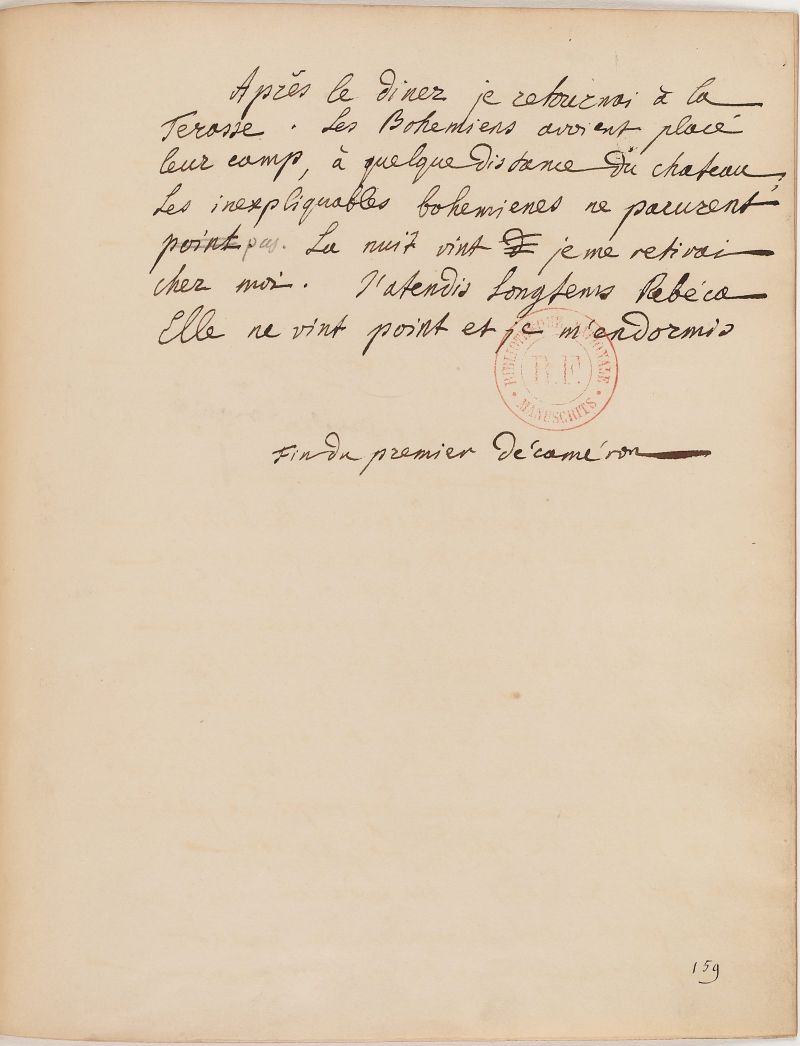
Jean Potocki, Alphonse Van Worden ou Manuscrit trouvé à Saragosse, Saint-Petersbourg, 1804-1805, Printer’s proofs of the first ten days (first decameron) with autograph corrections and additions
Cut up into days and organized into “decamerons” (ten-day segments), the adventures of the young Alphonse van Worden in the Sierra Morena plunge us into the heart of a dizzying narrative construction. In a tumbling jumble of nested stories a number of traditions are tapped into, ranging from demonology, fantasy, the Bible and esoteric sources, to encyclopedias, doctrines, treatises, and yarns worthy of earlier libertine writers. As the hero gains insight into himself and the world, this kaleidoscope of tales speaks to us of both the ambition to encompass all knowledge and the fragility of certainties when confronted with the experience of multiplicity and otherness.
Bringing together a unique collection of archival documents and artworks and rare editions, the show highlights the meandering story of The Manuscript Found in Saragossa, which has joined the masterpieces of world literature. At the point where The Thousand and One Nights, Laurence Sterne’s Tristram Shandy, Cervantes’s Don Quixote, and M.G. Lewis’s The Monk come together, this novel world, this teeming all-embracing book calls to us with surprising relevance today. In the face of proliferating narratives, before the many systems and doctrines of our world, how do we become subjects who are free to understand and choose?
![La Venta Quemada, [After 1814] Watercolor on paper for the [Manuscrit trouvé à Saragosse] | Non-autograph manuscript notebook titled The Ten Days of the Life of Alphonse Van Worden | containing the foreword and the first ten days](https://fondation-janmichalski.com/media/pages/agenda/manuscrit-trouve-a-saragosse/1fd403565a-1789396207/site_aquarelle_la-venta-quemada_manuscrit_trouve_a_saragosse_bcj-mp39_0006-2-800x-q80.jpg)
La Venta Quemada, [After 1814] Watercolor on paper for the [Manuscrit trouvé à Saragosse] | Non-autograph manuscript notebook titled The Ten Days of the Life of Alphonse Van Worden | containing the foreword and the first ten days
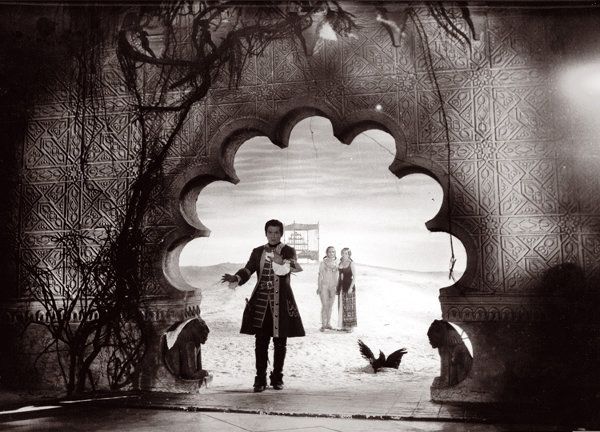
Wojciech Has, Le Manuscrit trouvé à Saragosse, 1965, Black-and-white film | 182 min | Screenplay by Tadeusz Kwiatkowski, based on Jean Potocki
At the library
Discover engravings by Kacper Bożek in dialogue with the exhibition The Manuscript Found in Saragossa: from Jean Potocki, investigation into a novel world
Curators
François Rosset, Honorary Professor at the Faculty of Arts, University of Lausanne; and Dominique Triaire, Professor Emeritus of French Literature, Paul Valéry University Montpellier
The following have contributed materials from their collections
Bibliothèque cantonale jurassienne, Porrentruy ; Bibliothèque de Genève ; Bibliothèque nationale de France, Paris ; Bibliothèque polonaise de Paris ; Médiathèque Émile Zola, Montpellier Méditerranée Métropole ; Médiathèque de Pontarlier ; Nautilus Gallery, Krakow ; National Archives, Poznań ; National Library of Poland, Warsaw ; Raczyński Library, Poznań ; University of Warsaw Library ; Jean Bonna Collection, Geneva ; Marek and Charlotte Potocki Collection ; Private Collections.
Visit the exhibition
Hours
Tuesday – Friday: 2 pm – 6 pm
Saturday – Sunday: 11 am – 6 pm
Admission
CHF 8.–: general admission
CHF 5.–: retirees, unemployed, disabled persons, groups (a minimum of 10 persons over 25 years old)
Free admission: under 25 years old, residents of Montricher, members of the library, Swiss Museum Pass, and the first Sunday of each month
Accessibility
Much of the exhibition’s content is displayed in table-style display cases 110 cm high. These display cases are therefore not accessible to wheelchair users.
We apologise for the lack of accessibility this causes.
Programme
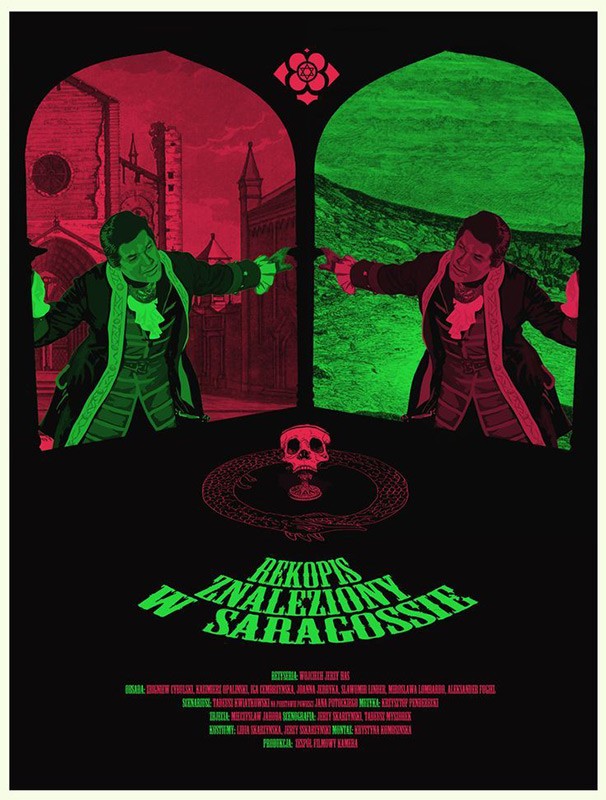
Film screening with commentary
“The Saragossa Manuscript” by Wojciech Has
Guided tour [in French]
The Manuscript Found in Saragossa
Film screening with commentary
“The Saragossa Manuscript” by Wojciech Has
Guided tour [in French]
The Manuscript Found in Saragossa
Jean Potocki, Dessins et notes du voyage en Espagne, [Between 1791 and 1794], Graphite pencil and watercolor | autograph notebook
Jean Potocki, Alphonse Van Worden ou Manuscrit trouvé à Saragosse, Saint-Petersbourg, 1804-1805, Printer’s proofs of the first ten days (first decameron) with autograph corrections and additions
La Venta Quemada, [After 1814] Watercolor on paper for the [Manuscrit trouvé à Saragosse] | Non-autograph manuscript notebook titled The Ten Days of the Life of Alphonse Van Worden | containing the foreword and the first ten days
Wojciech Has, Le Manuscrit trouvé à Saragosse, 1965, Black-and-white film | 182 min | Screenplay by Tadeusz Kwiatkowski, based on Jean Potocki